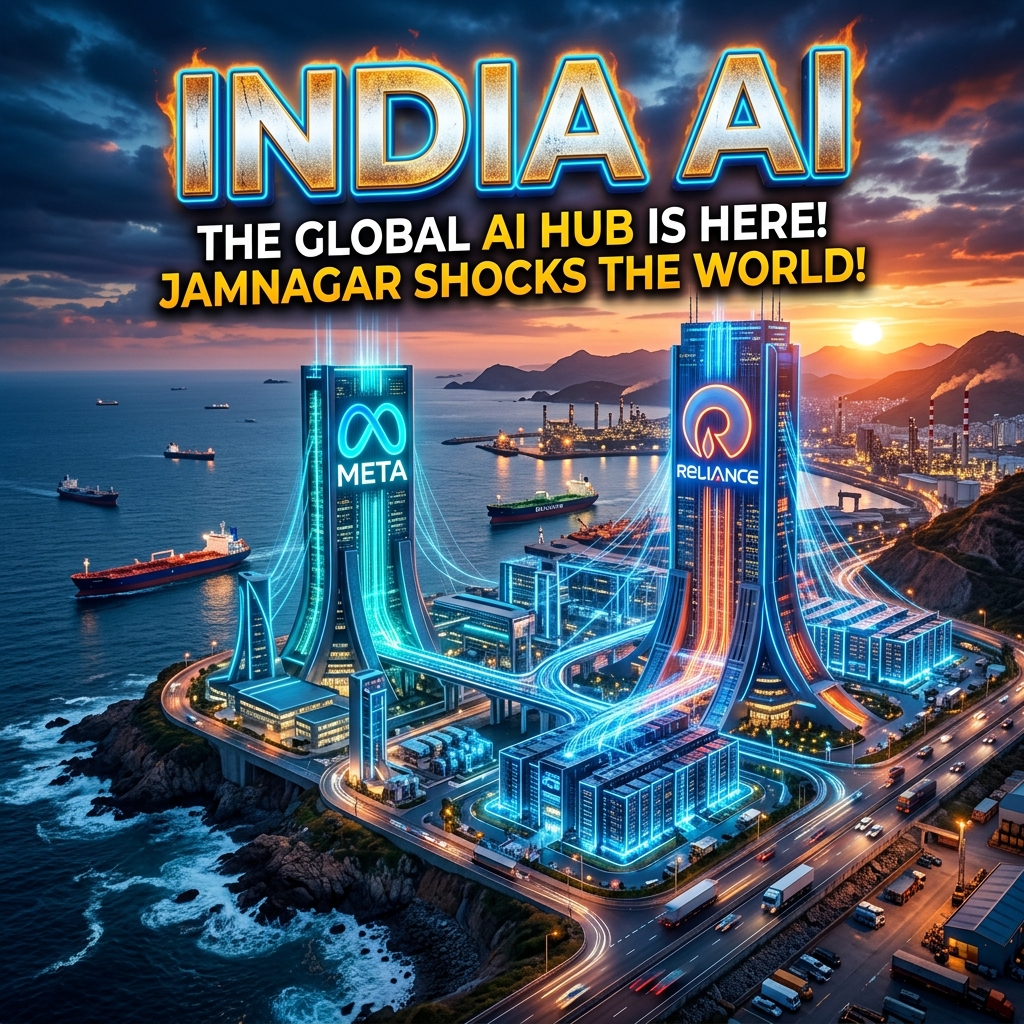
Meta and Reliance Industries have officially announced India's first AI-enabled data center in Jamnagar, Gujarat — a 168MW facility backed by renewable energy that could fundamentally shift how AI infrastructure is built and scaled across the entire country.
If you follow India's tech market, AI investment landscape, or the global race for compute power, this announcement deserves your full attention. This is not a routine data center deal. This is one of the most strategically significant AI infrastructure moves India has seen, and the details reveal exactly why Jamnagar was chosen and what comes next.
What Was Actually Announced
On June 9, 2026, Meta confirmed it has entered a formal agreement with Reliance Industries to lease its first AI-enabled data center in India. Reliance will design and build the facility in Jamnagar, Gujarat, with an initial capacity of 168 megawatts. Meta will lease the space to support its global products and AI capabilities.
The facility is designed with two notable features that go beyond typical data center infrastructure. First, it will be powered entirely by renewable energy. Second, it will be cooled using desalinated seawater — a technically advanced and environmentally significant choice that reflects the scale of heat output these AI systems generate. Meta has committed to covering the full cost of both the energy and water required to operate the facility.
Why India, and Why Jamnagar Specifically
India was not a random pick. Meta explicitly cited India's fast-growing digital economy and its massive, highly active user base as core reasons for the investment. India has one of the largest populations of Facebook and Instagram users in the world. WhatsApp is deeply embedded in everyday communication for hundreds of millions of Indians. The infrastructure needed to serve those users — and to build better AI experiences for them — has historically been handled from data centers outside the country. That is now changing.
Jamnagar, specifically, makes sense for several reasons. It sits on the western coast of Gujarat, giving it access to the Arabian Sea, which is essential for the seawater cooling system. Jamnagar is also already a hub for large-scale industrial infrastructure given Reliance's long-standing presence there. The logistics, land availability, power grid access, and industrial support ecosystem are all already in place. Building a cutting-edge data center here is far more practical than doing so in a crowded metro area.
Reliance described the deal as a transformative moment for India's digital infrastructure. That framing matters. This is not Reliance acting as a passive landlord. This is India's largest conglomerate actively positioning itself as the backbone of the country's AI compute layer — with Meta as its first major anchor tenant.
What Makes This an AI Data Center, Not Just a Data Center
The distinction between a standard data center and an AI-enabled data center is significant and worth understanding clearly.
A traditional data center stores data and handles general computing tasks. An AI-enabled data center is designed from the ground up to handle the specific hardware, power density, cooling requirements, and networking demands of modern AI workloads. This means it is built to house GPU clusters, support the high-bandwidth interconnects those systems require, handle power density levels that standard server infrastructure was never designed for, and maintain the thermal stability needed to keep those systems running without throttling.
Why This Matters for India's Tech Ecosystem
The implications of this deal extend well beyond Meta and Reliance.
For Indian developers and AI startups, local AI infrastructure matters enormously. Right now, many AI companies in India route their workloads through data centers in Singapore, the United States, or Europe. That creates latency, increases costs, and creates dependency on foreign infrastructure. A large-scale AI compute presence in India opens the door to faster, cheaper, and more reliable AI services for companies building in and for the Indian market.
For India as a country, this is part of a broader trend. The global AI race is increasingly being fought on the question of where compute lives. Nations and regions that build out serious AI infrastructure become more self-sufficient, more competitive, and more attractive to global technology investment. India has spent years being an AI consumer and talent exporter. This deal is part of a shift toward India becoming an AI infrastructure host as well.
The Renewable Energy Angle Is Not Just PR
It is worth pausing on the renewable energy and desalinated seawater cooling commitment, because it is more technically significant than it might appear.
Data centers are enormous energy consumers. AI data centers consume even more, because GPU clusters run at high utilization and generate massive amounts of heat that must be actively removed. The conventional approach to cooling — using fresh water from local municipal supplies or rivers — becomes unsustainable at this scale, particularly in a water-stressed region like western Gujarat.
Using desalinated seawater for cooling is a smarter engineering choice for this geography. It removes the dependency on freshwater sources, which are under pressure across much of India. Pairing that with renewable energy means the facility's carbon footprint is substantially lower than a comparable facility running on grid power from fossil fuels.
Meta covering the full cost of energy and water also removes a significant burden from local resources. This is the kind of project design that makes large-scale foreign tech investment more viable to host, because it does not come at the direct expense of local communities competing for the same energy and water supply.
What Happens Next
Meta has indicated that the Jamnagar facility includes options to scale beyond the initial 168MW capacity. That is a deliberate signal. The first phase is designed as a foundation, not a ceiling. If AI demand — both from Meta's own products and from the broader market — continues to grow at its current pace, the facility could expand significantly.
The Bigger Picture
There is a broader strategic story underneath this announcement that is worth naming directly.
The global AI competition is not just about who builds the best models. It is increasingly about who controls the infrastructure those models run on. Compute is the new oil, and data centers are the new refineries. The countries, companies, and partnerships that secure large-scale AI compute capacity now will have a structural advantage in the AI economy for decades.
Meta and Reliance are both making long-term bets with this deal. Meta is securing compute capacity in one of its most important markets. Reliance is positioning itself as the infrastructure partner of choice for global AI companies entering India. Both bets make sense. Both could pay off substantially.
For India, the bet is even larger. A country of 1.4 billion people with one of the world's fastest-growing digital economies now has a credible path toward becoming not just an AI user market, but an AI infrastructure destination. Jamnagar is the starting point.
Key Takeaways
Meta and Reliance have announced India's first AI-enabled data center in Jamnagar, Gujarat, with an initial capacity of 168MW. The facility will use renewable energy and desalinated seawater cooling, with Meta covering all operational energy and water costs. This is a significant signal that India is becoming a serious destination for AI infrastructure investment, not just AI users. The deal has scale-up options built in and could become a template for further AI infrastructure development across the country. For Indian developers, businesses, and users, more local AI compute means faster services, lower costs, and stronger capability over time.
Sources: Meta Official Announcement, June 9, 2026 | Reliance Industries Statement