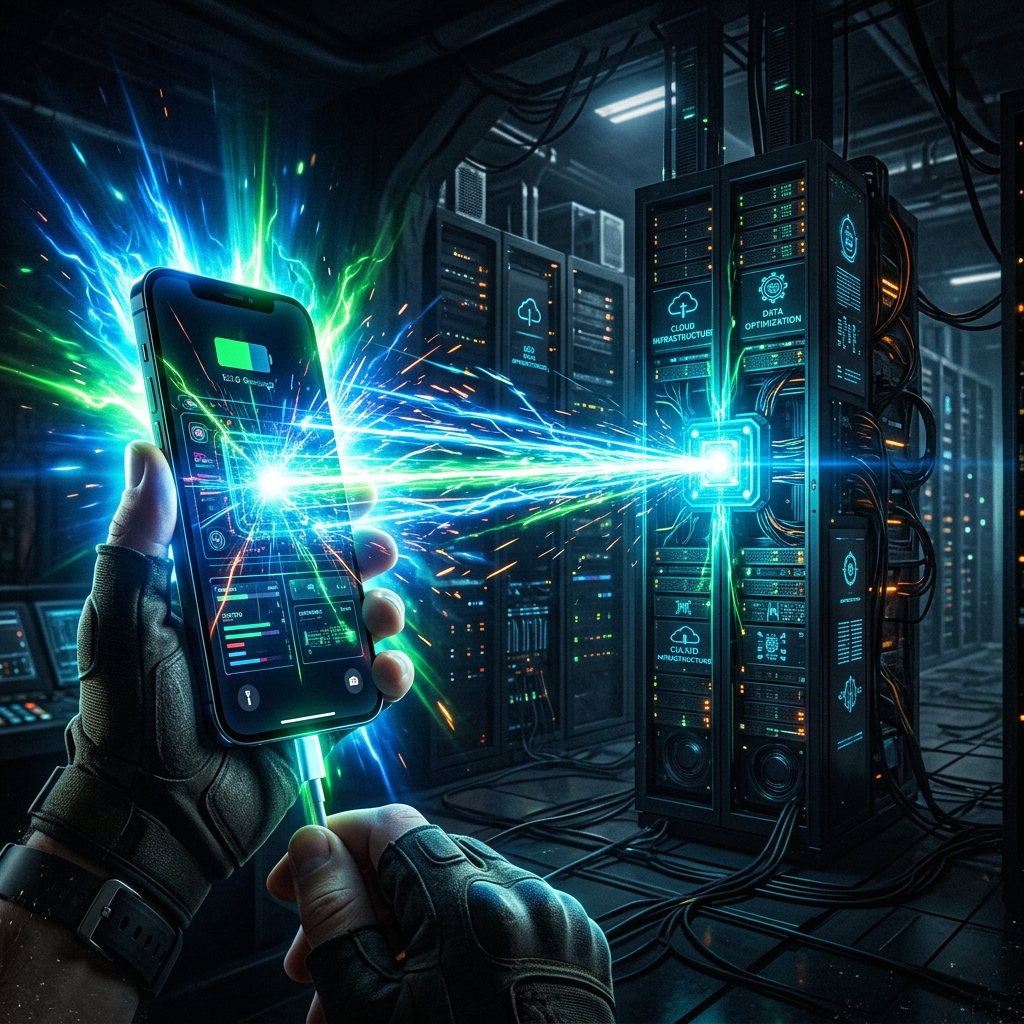
Apple quietly handed control of its most sensitive AI workloads to Google Cloud and NVIDIA Blackwell GPUs at WWDC 2026 — while keeping its ironclad privacy promise fully intact. Here's exactly what changed, why it matters, and what it means for your data.
What Just Happened (And Why It's a Big Deal)
At WWDC 2026, Apple announced that its Private Cloud Compute (PCC) system — the infrastructure that handles complex Apple Intelligence requests too demanding for on-device processing — is expanding beyond Apple's own data centers and onto Google Cloud for the first time.
Powering the new infrastructure is a trio of hardware: NVIDIA Blackwell GPUs with Confidential Computing, Intel CPUs with TDX, and Google's Titan security chip. Together, they form what Apple calls a comprehensive, end-to-end confidential inference pipeline — the first of its kind to operate at global scale.
The rollout is currently in preview and is expected to reach full operational capacity by the end of summer 2026.
What Is Apple Private Cloud Compute?
Launched in 2024, Private Cloud Compute is Apple's answer to a fundamental problem in AI: what happens to your personal data when your phone can't handle the request on its own?
Before PCC, the default industry answer was: it goes to a cloud server, where the provider has access to it. Apple's answer was different. PCC was built around five non-negotiable principles:
- Stateless computation — your data is processed, not stored
- Enforceable guarantees — security properties that can be technically verified, not just promised
- No privileged runtime access — even Apple's own engineers cannot access your requests
- Non-targetability — no one can direct the system to attack a specific user
- Verifiable transparency — independent security researchers can inspect the code running on servers
The expansion to Google Cloud does not change any of these principles. What changed is the hardware running underneath them.
What NVIDIA Brings to Apple's Privacy Stack
NVIDIA's role in this partnership is not about raw GPU power — it's about trust infrastructure.
NVIDIA Confidential Computing on Blackwell GPUs adds four critical layers to Apple's cloud security:
Hardware-rooted trust establishes that every system in the PCC fleet is running on genuine, untampered NVIDIA hardware — verified cryptographically before any sensitive data is sent.
Encrypted communication paths protect data as it moves between components, ensuring nothing is exposed in transit.
Remote attestation lets Apple's devices cryptographically verify that Google Cloud infrastructure has not been tampered with before a single byte of user data is sent.
Accelerated private inference means all of this security happens without sacrificing the performance needed for real-time AI tasks like agentic reasoning, complex research, and multi-step Siri requests.
NVIDIA has framed this as the model for all enterprise AI going forward: speed and privacy are no longer in competition.
Apple and Google: A Deeper Partnership Than It Looks
This PCC expansion is part of a broader relationship. In January 2026, Apple and Google signed a multi-year agreement to use Google's AI and cloud infrastructure across Apple's consumer device ecosystem. At WWDC 2026, Apple confirmed it also collaborated with Google to build the next generation of Apple Foundation Models using the technologies behind the Gemini model family.
The result is a system where Apple retains complete cryptographic control over all PCC software regardless of where the hardware lives. Apple devices will only trust PCC nodes that have been cryptographically approved by Apple — and Apple maintains a verifiable ledger of all Google Cloud hardware included in the PCC fleet to guard against supply chain attacks.
For users skeptical about their iPhone's data running through Google's servers, Apple's answer is architectural: the protections are not a policy promise. They are hardware-enforced and independently inspectable.
What This Means for Enterprise Users
For organizations evaluating Apple's AI stack in privacy-sensitive environments, the Google Cloud expansion is arguably good news — not a liability.
Here's why:
The new infrastructure maintains Apple's full PCC security model on third-party hardware. Security teams can verify the protections through Apple's transparency logs. Workloads are isolated at the hardware level, not just the software level. And the multi-vendor stack — Apple, Google, NVIDIA, Intel — means no single provider has a complete picture of a user's request.
From an enterprise AI procurement perspective, PCC on Google Cloud is one of the only cloud AI systems where the absence of data access is technically enforced rather than contractually promised.
The Bigger Signal: Privacy Is Now an Architecture Problem
What Apple, NVIDIA, and Google are building together is a direct answer to the AI industry's biggest unsolved challenge: how do you let AI process deeply personal data at cloud scale without creating a surveillance architecture underneath it?
Most providers respond to this question with policy: terms of service, data retention commitments, and compliance certifications. Apple's response is hardware. The system is designed so that the answer to "can Apple read my data?" is not "we promise they won't" — it's "the architecture makes it technically impossible."
That distinction is meaningful. And as AI systems become more deeply woven into daily workflows, it may become the most important competitive differentiation in the enterprise AI market.
Bottom Line
Apple just made its most significant AI infrastructure move since launching Private Cloud Compute in 2024. By extending PCC to Google Cloud with NVIDIA Blackwell GPUs, it is scaling its private AI system without compromising the privacy architecture that made PCC worth trusting in the first place. For users, that means more powerful Apple Intelligence. For enterprises, it means cloud AI that can be verified — not just trusted on faith.
Sources: NVIDIA Blog (June 9, 2026), Apple Security Research Blog (June 9, 2026), Data Center Dynamics, Help Net Security, MacRumors, Apple Insider.